
31 AUGUST 2026
When Tashkent Received New Delhi
The question is no longer whether India belongs in Central Asia's strategic calculus, but whether the partnerships it is building there can outpace the pace at which that region is being reshaped by larger powers.
Prime Minister Narendra Modi arrived in Tashkent on the evening of 29 August 2026, touching down in Uzbekistan for the fourth time in his tenure as India's head of government. President Shavkat Mirziyoyev was at the airport to receive him, a gesture that was less ceremonial than it was deliberate; the two countries had chosen this moment, coinciding with Uzbekistan's 35th Independence Day and the fifteenth anniversary of their existing strategic partnership, to mark a qualitative elevation in their relationship. By the time the two leaders had concluded their delegation-level talks the following afternoon, the India-Uzbekistan relationship had been formally upgraded to a Comprehensive Strategic Partnership, and Modi had been conferred with the Oliy Darajali Do'stlik Order, Uzbekistan's highest honour for visiting foreign leaders.
History offers a useful frame here. India and Uzbekistan share civilisational connections that predate the nation-state by many centuries; the Silk Road that once connected the Indian subcontinent with the markets of Samarkand and Bukhara carried not only goods but texts, musicians, craftsmen, and ideas. It is a history that both sides invoke with genuine feeling rather than diplomatic formality, and one that provides a cultural substratum on which modern policy can, at its best, build something durable. Modi's visit to the Lal Bahadur Shastri Memorial in Tashkent, where India's second Prime Minister died in January 1966, and to the Mahatma Gandhi Centre at Tashkent State University of Oriental Studies, was not incidental. It was an act of historical reclamation, a reminder that India's engagement with this part of the world is not a post-Soviet discovery but a relationship whose roots go considerably deeper than the diplomatic architecture of the twentieth century.
The substance of the talks, however, was unmistakably twenty-first century in its character and ambition. Bilateral trade between India and Uzbekistan currently stands at approximately $1.5 billion, a figure that both sides have acknowledged falls well short of the potential that the two economies represent. Commerce and Industry Minister Piyush Goyal has indicated that the target is to reach approximately $3 billion within three years, and the joint statement points toward a Preferential Trade Agreement as the institutional instrument through which that expansion might be channelled. A Joint Working Group has been established specifically to address non-tariff barriers and investment obstacles, which, in the practical language of bilateral trade diplomacy, amounts to an acknowledgement that the headline numbers require unglamorous administrative work beneath them to become real.
What distinguishes this particular visit from its predecessors is the degree to which cooperation in critical minerals has been elevated as a priority. The two sides agreed to collaborate in geological exploration, mining, mineral processing, and the development of integrated value chains, with Indian companies being invited to participate in the development of prospective mineral deposits on Uzbek territory. Given the context in which this agreement was reached, with global supply chains for critical minerals under considerable strain and both the United States and China actively competing for access to the rare earth and battery-grade mineral deposits of Central Asia, the strategic logic is clear. India's own energy transition requires lithium, cobalt, and a range of other materials that Uzbekistan may be positioned to supply. Formalising that relationship at the level of a Comprehensive Strategic Partnership gives it a degree of institutional resilience that would not have been available under the older, more narrowly defined framework.
The digital and technological dimension of the partnership deserves equal attention. The IT Park established in Tashkent in 2019, modelled on India's Software Technology Parks of India and built with active Indian technical support, has been functioning as a demonstration of what the two countries can accomplish when institutional cooperation is sustained over time. The two leaders agreed to expand the network of such technology parks and to deepen engagement between companies, startups, and educational institutions on both sides. Cooperation on artificial intelligence, including the exchange of best practices for the development of safe and trustworthy AI systems, was also formalised, building on earlier understandings reached in February 2026 on the margins of the India AI Impact Summit in New Delhi. In a region where digital transformation has been uneven and where the governance of emerging technologies remains contested, India's willingness to share models and expertise is both a contribution and a form of influence.
The security architecture that underpins the partnership was also given fresh substance. The Joint Working Group on Counter-Terrorism was reaffirmed, along with cooperation on law enforcement, intelligence-sharing, and the disruption of terrorist financing networks. The joint statement's language on terrorism was notably unambiguous, condemning cross-border terrorism in all its forms and calling for the accountability of perpetrators, their backers, and their affiliates. The Uzbekistan-India Joint Military Exercise Dustlik, the most recent edition of which was held in the Namangan Region in April 2026, reflects a defence relationship that has moved beyond mere protocol into genuine operational cooperation. A Joint Working Group on Military Cooperation is actively exploring new avenues in the defence industrial domain, which suggests that the two countries are beginning to think about the relationship not only in terms of shared threats but in terms of shared production and supply.
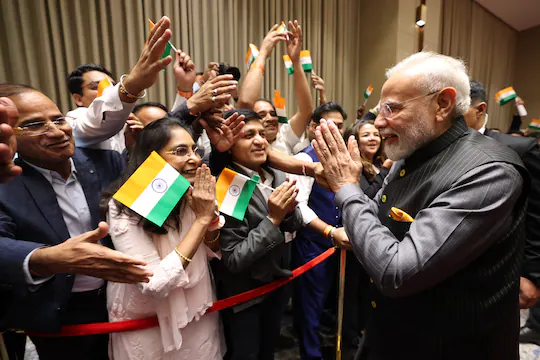
I believe the most underappreciated dimension of Modi's Tashkent visit, however, lies not in the strategic documents but in the texture of the public engagements that surrounded them. The Indian diaspora in Uzbekistan greeted the Prime Minister with the kind of warmth that is difficult to manufacture and easy to read: a living bridge, as Modi himself noted, between the two societies. He watched a fusion of Kathak and Andijan Polka dances, alongside a children's performance of the classic Hindi film song Ude Jab Jab Zulfe Teri, and participated in a yoga programme organised by the Yoga Federation of Uzbekistan on the morning of 30 August. These are not merely the cultural ornaments of a diplomatic visit. They are evidence of a people-to-people connection that is dense enough to be experienced in the street rather than only proclaimed in joint statements; over 2,700 Uzbek nationals have trained under India's ITEC programme, more than 400 Uzbek students have received ICCR scholarships, and the new Lal Bahadur Shastri Scholarship for Hindi Language in Uzbekistan will add another thread to that fabric.
The Aral Sea, one of the most visible ecological disasters of the twentieth century, also entered the bilateral agenda in a form that is modest but symbolically significant. India has committed $1 million under its Grant-in-Aid framework to support the greening and ecological rehabilitation of the Aral Sea region, linking its own domestic initiative Ek Ped Maa Ke Naam to Uzbekistan's Yashil Makon ecological programme. A Letter of Intent on the conservation and restoration of the ancient Buddhist sites of Fayaz Tepa and Karatepa was also signed, connecting India's cultural diplomacy to a heritage that belongs, in a very literal sense, to both civilisations.
Uzbekistan, for its part, has reaffirmed its support for India's candidature for permanent membership of the United Nations Security Council, a position that carries particular weight at a moment when the reform of multilateral institutions is once again becoming a live question rather than a ceremonial aspiration. Both sides also agreed to strengthen coordination within the framework of the Shanghai Cooperation Organisation, which will be the next stop on Modi's itinerary: he is scheduled to travel from Tashkent to Bishkek for the 26th SCO Summit on 31 August and 1 September, where the regional security architecture and India's position within it will be tested against a considerably more complex set of dynamics than those on display in the warmth of the bilateral talks.
At the same time, a clear-eyed assessment of the visit requires acknowledging the structural constraints within which it takes place. India's connectivity to Central Asia remains limited by geography and by the absence of a direct overland route that does not pass through either Pakistan or Iran, both of which present their own complications. The International North-South Transport Corridor, which runs through Iran, is one partial answer, but it remains incomplete. Bilateral trade of $1.5 billion, however ambitious the target of $3 billion may be, reflects a relationship that still operates well below its natural ceiling. The joint statement's language on transport and logistics, while constructive, acknowledges the ongoing challenge of reducing transportation costs and developing multimodal corridors without fully resolving the structural geography that makes those corridors difficult to build.
Whether the elevation to a Comprehensive Strategic Partnership proves to be the beginning of a genuinely deeper engagement or another layer of diplomatic nomenclature applied to a relationship that continues to be constrained by practical obstacles will depend, as it always does, on the choices made in the months and years after the communiques have been signed. The architecture is now in place: a Foreign Ministers-led coordination mechanism, working groups on trade, defence, counter-terrorism, and critical minerals, and a Cultural Exchange Programme running through 2030. Whether those institutions are filled with sustained political will and administrative follow-through, or allowed to drift into intermittent activity, is a question that Tashkent and New Delhi will have to answer together, long after the warmth of this particular August has faded.