
15 OCTOBER 2026
The Mecca Defence Pact: Promises, Contradictions and Implications
On August 7, 2026, leaders from three majority Islamic nations represented by the Saudi Crown and Prime Minister Prince Mohammed bin Salman, Turkish President Recep Tayyip Erdogan, and Pakistani Prime Minister Shehbaz Sharif met at Mecca to sign a Joint Defence Agreement. The pact was modelled around NATO Article 5, establishing that an attack on one would be considered an attack against each one of the other patrons.
Some analysts consider this to be an extension of the bilateral pact signed between Pakistan and Saudi Arabia last September. Saudi Arabia had also signed an executive defense cooperation during President Erdoğan's Gulf tour in 2023 and also major acquisition contracts with Turkish defense firm Baykar. Saudi’s close ties with these nations can be seen as a reconsideration of its over reliance on the west. The pact also stands to catalyze Saudi Arabia's Vision 2030 push to localize over half its defence spending by 2030.
The alliance has also signalled that it is open to other Sunni Muslim-majority countries. Turkish Foreign Minister Hakan Fidan has described Egypt as a natural partner. Bangladesh’s Foreign Minister Khalilur Rahman has presented any possible membership as an internal matter for the “Muslim family” and a step toward self-defence rather than a challenge to anyone else.
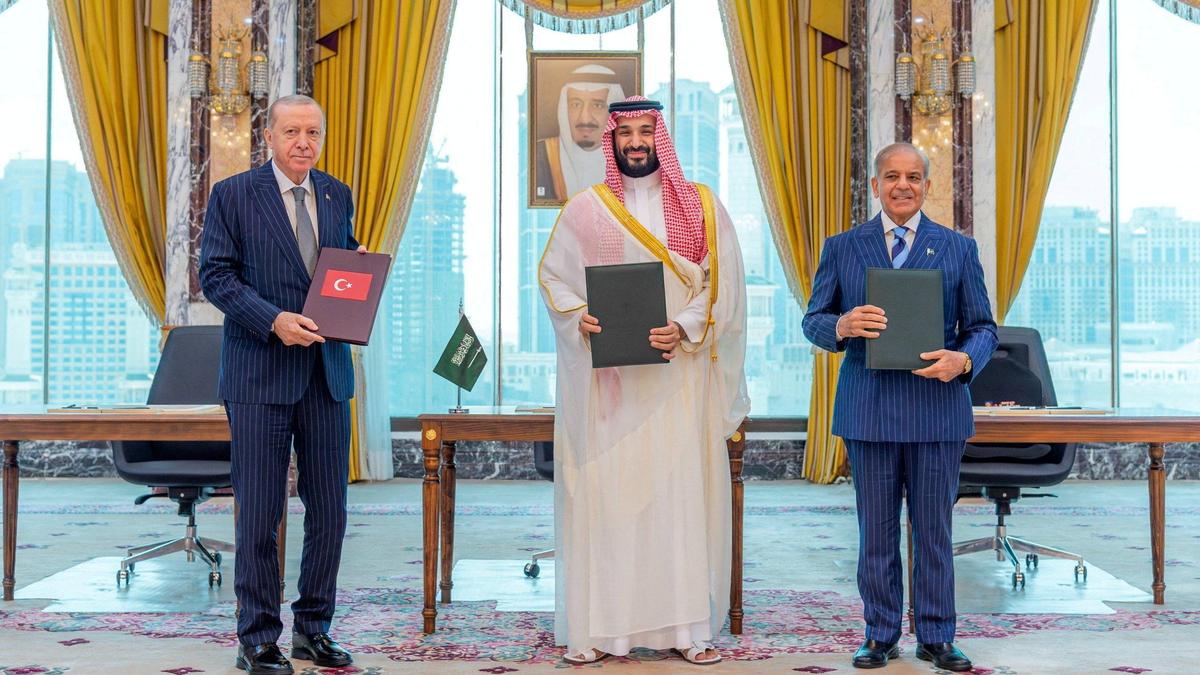
On paper, this pact is of mutual benefit to all parties. Saudi Arabia brings in its petrodollar wealth, tying together Pakistan’s military capabilities and Turkey’s industrial defense production capabilities, thus posing as a new front in the region. For Pakistan, which had gained traction earlier this year, brokering relations between Iran and the United States with a 14 point peace deal, joining this group of majority Islamic powers would be another boost despite the many domestic headwinds at home.
However, within just six weeks of signing the Mecca Joint Defence Agreement, Saudi Arabia was targeted in waves of strikes, including an assault that reached its capital city. Just two days after the pact was signed, the Houthis deployed drones on the 9th of August to strike Saudi Aramco’s Jazan oil refinery, igniting a fire at the facility.
That early attack could already have tested the new collective defence promise with Pakistan. Instead, the article of collective defence was not operated. A senior Turkish official said the defence commitments in the treaty were not yet legally active, and that the institutions and military arrangements needed to put them into practice would take time to build. Pakistan said it had received no request from Saudi Arabia to step in.
Rather than acting, the members met on 31 August in Istanbul for the first sitting of the Strategic Political and Defence Committee. There they agreed to set up a permanent secretariat in Riyadh, with Pakistan as chair for the first three years. In other words, they chose a bureaucratic set-up of meetings and offices while military threats were unresolved.
The following month, the attacks intensified. On 8 September a second wave of drone and missile strikes hit southern targets and energy infrastructure in Abha, Najran and Jizan. On 10 and 11 September a third wave targeted the vital East-West Pipeline, forcing a complete shutdown of the crude export route. The escalation reached its peak on 19 September, when a strike on Riyadh ignited heavy fires near King Khalid International Airport alongside concurrent attacks on sensitive sites across the capital, Yanbu and southern territory.
Beyond the proven non-action of either patrons of the pact there are other contradictions with this trilateral alliance. Saudi Arabia has positioned itself as a modern state that stands against political Islam, and it designated the Muslim Brotherhood a terrorist group. Now it has tied its own security to Turkey, a country that has backed the Brotherhood for years. At the same time, Riyadh wants India as a central partner in the India-Middle East-Europe Economic Corridor, for Indian trade, technology and goodwill from the more than 2.5 million Indians living in the kingdom. It is also funding a defence pact with Pakistan, a country that has long caused cross-border terrorism in India. Economic ties with India and military ties with Pakistan is a policy that is indefensible for the kingdom.
Just a day after the pact was signed, Pakistan’s Defence Minister Khawaja Asif called for a broader “Islamic NATO” and declared that on the question of Israel the entire Muslim Ummah must stand united, with no room for disagreement. Turkish Foreign Minister Hakan Fidan, in response to a question, slammed the Israeli administration, and singled out Israeli Prime Minister Benjamin Netanyahu, addressing him as a murderer and a common enemy of humanity. These statements don't sit well particularly with the order post, Abraham Accords which had already brought the UAE and Israel into formal ties, and there were signs that Saudi Arabia itself was moving toward possible normalisation with Israel. By pushing for a united military front against Israel so soon after the Mecca agreement, Islamabad’s posture shifted the tone of the new pact. What had been presented as a defensive arrangement among three countries carried the language of a wider anti-Israel alliance.
While watching all of this, India's counter-strategy has been to grow closer to Israel and the UAE. Israel has been India's biggest source of defence technology in the region, selling India missile systems, drones and surveillance equipment, and the two countries have talked about building a 10-year defence cooperation plan together. Similarly, with the UAE. India has signed a free trade deal in 2022, and the two countries have been holding regular defence talks, the most recent one covering training programmes and maritime security cooperation. These two relationships come together, along with the US, in the I2U2, formed in 2021, which after the Abraham Accords opened the door for Israel and the UAE to work together. I2U2 started out as an economic project, focused on trade and technology, with estimates putting future India-Israel-UAE trade at over 100 billion dollars a year.
The Mecca pact was conceived as a demonstration of regional strength, but the strikes that followed exposed how commitments on paper could unravel when tested by actual conflict, a fragility that compounds the contradictions already inherent in the arrangement. The pact remains, by most assessments, some distance from operational maturity, and its trajectory over the next year, whether the secretariat gains substance or remains symbolic, will be more instructive than its founding text.
For India, the episode reinforces the necessity for strategic autonomy rather than dependence on external assurances. The Mecca pact’s dynamics creates space for India to deepen its own partnerships with the countries that share India's interest in a stable Gulf and a comparable scepticism toward Islamabad's newest patrons. Pairing indigenous defence capacity and economic weight with these calibrated relationships would allow India's security posture to rest on demonstrated capability and tested partnerships, rather than on the kind of unfulfilled guarantees the Mecca pact has so far offered its own members.